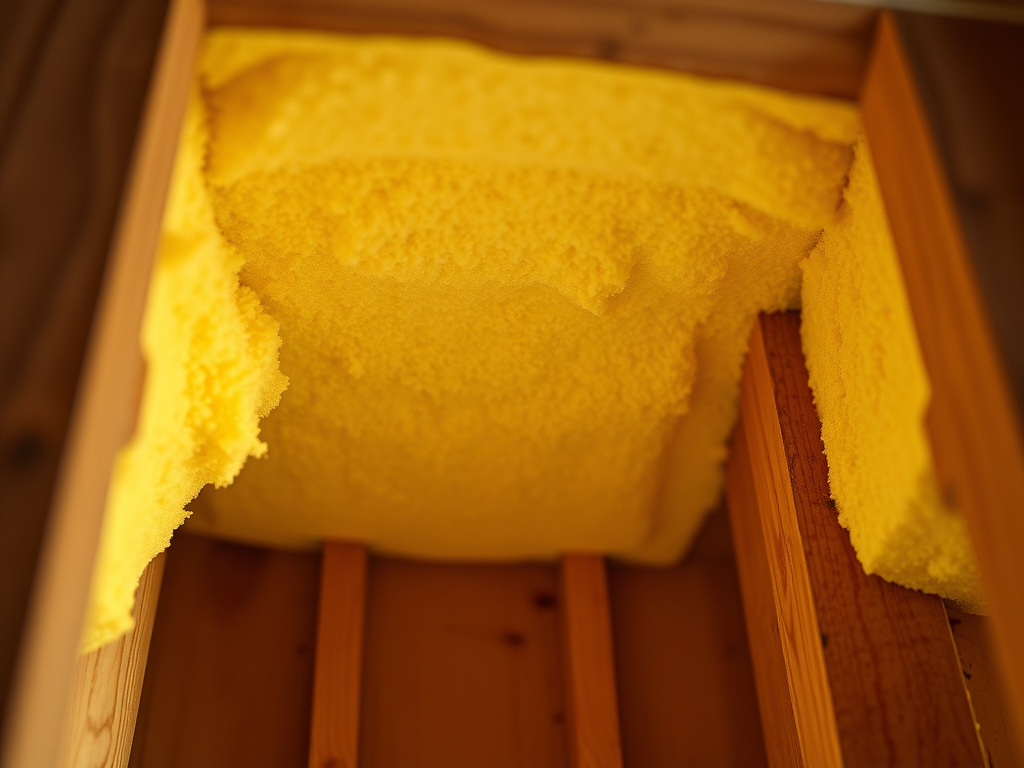
Spray Foam 101 Guide
What Is Spray Foam Insulation?
A straightforward look at what spray foam insulation actually is, how it works, and why it behaves so differently from traditional insulation materials.
The Basic Chemistry: Two Liquids Become One Solid
Spray foam insulation starts as two separate liquid chemicals that are stored in pressurized drums and kept apart until the moment of application. Side A is typically an isocyanate, most commonly a form of MDI (methylene diphenyl diisocyanate). Side B is a polyol resin blended with catalysts, blowing agents, surfactants, and fire retardants. Neither liquid does much of anything useful on its own.
When a trained installer pulls the trigger on a spray gun, the equipment meters the two components at a precise 1:1 ratio and forces them through a mixing chamber under high pressure and heat. The moment isocyanate and polyol combine, an exothermic chemical reaction begins immediately. Within seconds the mixture starts expanding, and within roughly 8 to 60 seconds, depending on the specific formulation, it has expanded to many times its liquid volume and begun to solidify into a rigid or semi-rigid polyurethane foam matrix.
This is fundamentally different from every other common insulation material, none of which involve an on-site chemical reaction. Fiberglass, cellulose, and rigid foam board are manufactured off-site and simply installed as pre-formed products. Spray foam is manufactured in place, inside the wall cavity or attic, which is exactly why it can conform to oddly shaped framing, wiring, and plumbing in a way that pre-cut materials cannot.
The blowing agent in the formulation is what creates the gas that expands the reacting liquid into a cellular foam structure. Modern residential formulations have largely moved to water-blown or hydrofluoroolefin-blown chemistries, both considered lower-impact than the older blowing agents used decades ago, while still delivering the expansion and insulating performance the material is known for.
How Installation Actually Works
A professional spray foam crew arrives with a rig that houses the two chemical drums, a proportioner that heats and pressurizes each component, and long heated hoses running to a spray gun. Getting the ratio, temperature, and pressure right is not optional. Even a small imbalance between the two sides can produce foam that never fully cures, stays soft, shrinks, or off-gasses longer than it should. This is one of the main reasons spray foam is considered a specialty trade rather than a weekend do-it-yourself project for whole-house jobs.
The installer sprays the mixture directly onto the substrate, such as rafters, studs, foundation walls, or rim joists, in controlled passes, building up to the target thickness in multiple lifts if a thick application is needed. As it expands, the foam fills gaps, seams, penetrations, and irregular framing that rigid materials would leave gapped. Within minutes it is tack-free; full cure to final physical properties generally takes anywhere from a few hours to about 24 hours depending on the product and site conditions.
Because the foam expands significantly, installers control thickness carefully to avoid overspray, bowing of thin materials, or blocking mechanical components that need clearance, such as electrical boxes or recessed lighting housings.
Equipment temperature and hose length also matter more than most homeowners expect. The two chemicals need to stay within a specific temperature range through the entire hose run to react correctly, which is why rigs use heated hoses and why crews monitor ambient jobsite temperature before and during a spray session, especially on very cold or very hot days.
How Spray Foam Differs From Fiberglass Batts
Fiberglass batts are pre-cut mats of spun glass fiber that trap air pockets to slow heat transfer. They only insulate against conductive heat flow. They do essentially nothing to stop air from moving through gaps, and air movement is one of the largest sources of energy loss in a typical home. Batts also rely on a snug, gap-free fit to perform anywhere near their rated value, and in real-world installations they are frequently compressed, gapped around wiring, or cut short, which can push their real-world performance well below the number printed on the package.
Spray foam, particularly closed-cell foam, does both jobs at once: it resists conductive heat flow and it physically seals the cavity against air leakage, since the foam expands to fill every crack and penetration it touches. That dual action is the single biggest functional difference between foam and batts.
How Spray Foam Differs From Cellulose and Rigid Foam Board
Loose-fill cellulose, made from recycled and treated paper fiber, is blown into attics or dense-packed into wall cavities. Like fiberglass, it slows conductive heat flow reasonably well and can reduce some air movement when dense-packed, but it is not an air barrier in the way cured spray foam is, and it can settle or absorb moisture over time if it gets wet.
Rigid foam board, whether EPS, XPS, or polyiso panels, is manufactured off-site as solid sheets and cut to fit. It has good, consistent R-value per inch and can act as an air barrier if every seam is taped and sealed, but achieving that seal in the field depends entirely on installation quality at every joint. Spray foam skips that step because it is liquid-applied and self-sealing by nature; there are no seams to tape in a cavity that has been fully filled.
Air Sealing vs. Thermal Resistance: Two Different Jobs
It helps to think of insulation performance as two separate jobs. Thermal resistance, or R-value, slows down heat that is conducting through a material. Air sealing stops air, and the moisture, dust, and energy it carries, from moving through gaps and cracks altogether. A material can have a high R-value and still perform poorly in a real house if it does nothing to stop air leakage.
This is why a home insulated only with high-R fiberglass can still feel drafty and cost more to heat and cool than the R-value alone would suggest. Spray foam earned its reputation in the building science community largely because it addresses both variables at once in a single application, a topic covered in more depth on our R-value and energy savings page.
A Brief History and Where Spray Foam Is Used Today
Polyurethane spray foam chemistry has roots going back to the mid-20th century, but it became widely available for residential insulation starting in the 1980s and 1990s as formulations, equipment, and blowing agents improved. Early blowing agents raised environmental concerns; the industry has since shifted toward lower-impact hydrofluoroolefin blowing agents in most modern closed-cell products.
Today spray foam is common in new-construction wall cavities, attics (both vented and unvented conditioned-attic designs), crawlspaces, rim joists, pole barns, metal buildings, and retrofit projects where a homeowner wants to seal and insulate hard-to-reach or leak-prone areas. It is also widely used commercially on roofing systems, though residential envelope work is the focus of this site.
General Pros and Cons at a Glance
Every insulation material involves trade-offs, and spray foam is no exception. Understanding the general shape of those trade-offs helps set expectations before diving into the more detailed comparison and cost pages elsewhere on this site.
- Pros: superior air sealing, fills irregular cavities and penetrations, adds some structural rigidity with closed-cell foam, resists moisture and pest intrusion better than fibrous materials, does not settle or sag over time once cured
- Cons: higher upfront cost per square foot than batts or blown-in cellulose, requires trained professional installation for correct mixing and curing, needs temporary evacuation of the space during application and initial cure, harder to modify or remove later than loose-fill materials
Frequently Asked Questions
No. Canned foam sealant, the kind sold in hardware stores, is a single-component product designed for small gaps and cracks. Professional spray foam insulation is a two-component system mixed and applied with specialized equipment, and it is engineered to insulate and air-seal large surface areas.
Yes, that is how it fills a cavity. Liquid spray foam expands rapidly, often 30 to 120 times its original liquid volume depending on the formulation, within seconds of application, then hardens into its final shape as it cures.
It can be used in most areas, including attics, walls, crawlspaces, and rim joists, but the right foam type and thickness depend on the specific application. See our attic, crawlspace, and wall applications page for area-specific guidance.
Properly installed spray foam is a durable, stable material that generally lasts the life of the building without settling, sagging, or losing significant R-value, unlike some loose-fill materials that can compact over decades.
More Guides
Open-Cell vs Closed-Cell Foam
Density, R-value, moisture handling, and cost differences between open-cell and closed-cell spray foam, plus which one fits your project.
Read the guideR-Value & Energy Savings
What R-value really measures, why air sealing matters just as much, recommended targets by area, and realistic energy savings from spray foam.
Read the guideAttic, Crawlspace & Wall Applications
How spray foam application changes by area of the house — attic roofline vs. floor, open-cavity vs. injection walls, and crawlspace encapsulation.
Read the guideReady to see what spray foam costs for your project?
Tell us about your space and get connected with a vetted local installer for a free, no-obligation quote.