Spray Foam 101 Guide
Open-Cell vs Closed-Cell Spray Foam Insulation
Two very different products share the name "spray foam." Here is how open-cell and closed-cell foam actually compare, and where each one makes sense.
What Makes Them Different at a Cellular Level
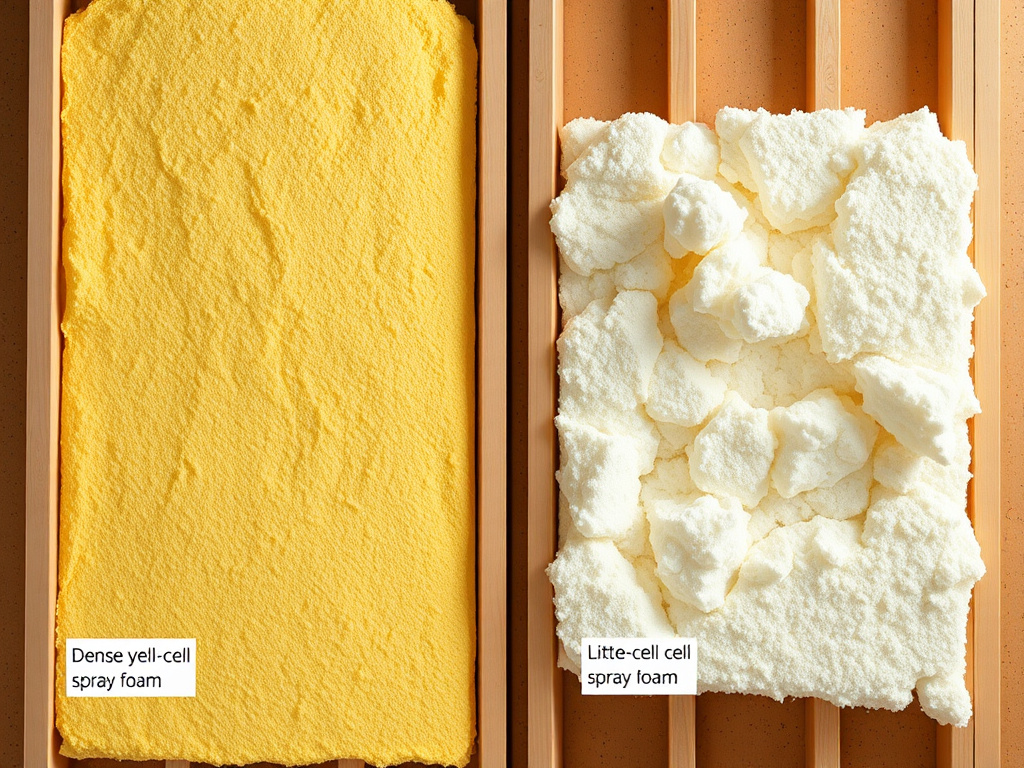
Both open-cell and closed-cell spray foam start from the same basic two-component polyurethane chemistry, but the formulation and blowing agent change how the foam cures at a microscopic level. In open-cell foam, the tiny cells that form as the foam expands are intentionally left open and interconnected, similar to a sponge. That open structure is why the cured foam is soft, spongy, and easy to press a finger into.
In closed-cell foam, most of the cells form as tiny sealed pockets, each one trapping a gas that boosts the material insulating value. That closed structure is why cured closed-cell foam is rigid, dense, and feels almost like a hard plastic when you knock on it. The cellular structure, not the color or the spray equipment, is the real dividing line between the two products.
Installers can usually tell the two apart within seconds of a job walkthrough. Open-cell foam looks like a pale yellow sponge cake and can be dented or torn by hand. Closed-cell foam, usually a shade of off-white, tan, or light gray depending on the manufacturer, has a smooth, glassy surface texture and requires a blade or saw to cut cleanly. Neither appearance difference affects performance directly, but it is a quick way for a homeowner to visually confirm which product was actually sprayed.
Density and Weight
Open-cell foam is a low-density product, typically around 0.5 pounds per cubic foot once cured. It is light enough that it will not add meaningful structural load anywhere it is installed, which is part of why it is well suited to broad attic-plane applications where a large volume of material is sprayed.
Closed-cell foam is much denser, typically in the range of 1.7 to 2.2 pounds per cubic foot. That density is part of why it costs more per board foot and why it is the material of choice in applications where added rigidity or load-bearing contribution matters. On large roof-deck or wall-sheathing jobs, the added weight of closed-cell foam is a minor factor engineers and installers do account for, though it is rarely significant enough to require additional framing support in typical residential applications.
R-Value Per Inch
R-value per inch is one of the most-cited differences between the two products, and for good reason. Open-cell foam typically rates around R-3.5 to R-3.8 per inch. Closed-cell foam typically rates around R-6 to R-7 per inch, roughly double the insulating power in the same physical space.
That gap matters most where cavity depth is limited. In a standard 2x4 wall with roughly 3.5 inches of depth, closed-cell foam can reach R-21 to R-24.5 in that space, while open-cell foam tops out closer to R-13. In a deep, open attic cavity where thickness is not constrained, the practical difference narrows because open-cell foam can simply be sprayed thicker to hit the same target R-value.
This is why the choice is rarely just "which foam is better" in the abstract. A 2x6 exterior wall, a shallow rim joist cavity, and an open attic plane each present a different amount of usable depth, and the foam that reaches a target R-value most efficiently in a shallow cavity is not necessarily the most cost-effective choice once depth stops being a constraint.
Moisture and Vapor Permeability
Closed-cell foam is largely impermeable to both air and liquid water once cured, and at roughly 2 inches or more of thickness it functions as a Class II vapor retarder. That makes it a strong choice in places that face direct moisture exposure or occasional water contact, such as crawlspace walls, rim joists, and below-grade foundation applications.
Open-cell foam is air-impermeable but vapor-permeable, meaning it blocks drafts while still allowing water vapor to pass through and dry in either direction. In the right wall assembly that permeability is a feature, letting incidental moisture migrate out rather than getting trapped against a vapor-tight layer. Getting this choice wrong in the wrong assembly, however, can contribute to moisture problems, which is why professional guidance on vapor strategy matters for whole-wall applications.
Climate plays a direct role here as well. In humid, mixed, or cold climates, vapor strategy on exterior walls needs to be planned carefully regardless of which foam is chosen, since trapping moisture on the wrong side of a wall assembly can lead to condensation inside the cavity over time. A qualified contractor accounts for local climate, wall orientation, and interior humidity levels when recommending open-cell versus closed-cell for a given wall assembly, rather than defaulting to one product everywhere.
Structural Rigidity and Sound Dampening
Because closed-cell foam cures rigid and bonds tightly to framing and sheathing, it adds meaningful racking strength to a wall assembly. Some engineered and manufactured-housing applications specifically rely on closed-cell foam contribution to lateral strength, on top of its insulating role.
Open-cell foam, by contrast, is prized for sound control. Its soft, open cellular structure absorbs airborne sound far better than closed-cell foam or fiberglass batts of similar thickness, which is why it is a popular choice for interior partition walls around home theaters, bedrooms, and offices where noise transfer between rooms is a concern.
Cost Per Board Foot
Open-cell foam is generally the less expensive of the two products on a per-board-foot basis, reflecting its lower density and lower material cost. Closed-cell foam typically costs noticeably more per board foot, driven by its higher density, the added blowing agent volume, and its higher-performance formulation.
That said, because closed-cell delivers roughly double the R-value per inch, the total installed cost gap for reaching a given target R-value is often smaller than the per-board-foot numbers alone suggest. Full pricing detail, including realistic 2026 ranges, is covered on our spray foam cost guide.
Best Use Cases for Each Type
Closed-cell foam tends to be the better fit for crawlspaces, rim joists, foundation walls, exterior applications, roof decks, and any area where moisture exposure, added rigidity, or maximum R-value per inch in a shallow cavity is a priority.
Open-cell foam tends to be the better fit for large, open attic cavities where depth is not constrained, interior sound-dampening walls, and budget-sensitive whole-attic projects where its lower cost per board foot and strong air-sealing performance deliver good value without the moisture-barrier properties closed-cell provides.
Fire Performance and Code Requirements
Both open-cell and closed-cell spray foam are combustible materials in their raw form and are manufactured with fire retardants to meet building code flame-spread and smoke-development requirements. Neither product is designed to be left exposed in a finished, occupied space. Building codes generally require an approved thermal or ignition barrier, such as drywall, over spray foam in living areas, with some specially tested foam products approved for limited exposed use in attics or crawlspaces under specific conditions.
This requirement is the same regardless of whether open-cell or closed-cell foam is used, so it should not be treated as a point of differentiation between the two when planning a project. A qualified contractor will know the correct barrier requirements for your local code jurisdiction and will not leave foam permanently exposed in a way that violates it.
A Simple Decision Guide
If the area faces direct moisture exposure, has limited cavity depth, or needs added structural contribution, closed-cell foam is usually the right call. If the area is a large, dry, open cavity like a vented attic, or the priority is sound control on interior walls within a reasonable budget, open-cell foam is usually the more cost-effective choice.
Many whole-house projects actually use both: closed-cell in the crawlspace and rim joists, open-cell in the attic. A qualified contractor can walk through the specific assembly, climate, and budget to recommend the right foam, or combination of foams, for each area of the home.
Frequently Asked Questions
Neither is universally better. Closed-cell offers a higher R-value per inch, moisture resistance, and structural rigidity, while open-cell costs less per board foot and dampens sound better. The right choice depends on the specific area of the home, moisture exposure, cavity depth, and budget.
Yes. It is common and often cost-effective to use closed-cell foam in moisture-prone or shallow areas like crawlspaces and rim joists, and open-cell foam in large, dry attic cavities.
On a per-board-foot basis, yes, closed-cell foam typically costs more. But because it delivers roughly double the R-value per inch, the total installed cost to reach the same target R-value can be closer than the per-board-foot price alone suggests.
No. Open-cell foam is air-impermeable but vapor-permeable and will absorb water if it stays wet. Closed-cell foam has a much higher resistance to liquid water intrusion, which is why it is favored in areas with direct moisture exposure.
More Guides
What Is Spray Foam Insulation
A plain-English breakdown of spray foam insulation: the two-part chemistry, how it expands and cures, and how it differs from batts, cellulose, and foam board.
Read the guideSpray Foam Insulation Cost Guide
Realistic 2026 price ranges for open-cell and closed-cell spray foam, what drives cost up or down, and how to spot a lowball quote.
Read the guideAttic, Crawlspace & Wall Applications
How spray foam application changes by area of the house — attic roofline vs. floor, open-cavity vs. injection walls, and crawlspace encapsulation.
Read the guideReady to see what spray foam costs for your project?
Tell us about your space and get connected with a vetted local installer for a free, no-obligation quote.