Spray Foam 101 Guide
Spray Foam Applications by Area: Attic, Crawlspace, and Walls
The right foam type, thickness, and technique depend heavily on where in the house it is going. Here is how each area is typically approached.
The Same Material, Different Jobs
Spray polyurethane foam is a single family of materials, but the way it gets used changes a lot depending on which part of the house it is treating. An attic roofline needs a different thickness and often a different foam type than a garage ceiling. A finished wall that already has drywall on it needs a completely different application method than a stud bay in a new-construction house. Understanding these differences helps homeowners ask better questions and recognize whether a proposed scope of work actually matches the area being treated.
The two broad categories of spray foam — open-cell and closed-cell — both show up across these applications, but each area tends to have a foam type and thickness range that installers reach for most often based on cost, moisture exposure, and the air-sealing and vapor-control goals of that specific space. This page walks through attics, walls, crawlspaces, rim joists, and garage ceilings or basements one at a time.
Attic: Roofline vs. Attic Floor
There are two very different ways to insulate an attic with spray foam, and the choice changes how the whole space functions. Spraying the underside of the roof deck and gable end walls creates what is usually called a conditioned or unvented attic — the attic becomes part of the home's thermal envelope, HVAC ducts and equipment in the attic end up inside the conditioned space, and attic temperatures stay much closer to the rest of the house. This approach is popular in hot, humid climates and in homes with ductwork running through the attic, since it keeps that ductwork out of extreme heat.
The alternative is spraying the attic floor, which keeps the traditional vented-attic setup — the attic stays closer to outdoor temperature, and insulation sits between and over the ceiling joists instead of on the roofline. This is a simpler retrofit in many existing homes, especially where the attic floor is easy to access and there is no ductwork or equipment up there that would benefit from being brought inside the envelope.
Roofline applications commonly use closed-cell foam at a couple of inches to meet code-minimum ignition barrier and air-sealing requirements, sometimes paired with open-cell foam to fill the rest of the rafter bay more economically. Attic floor applications more often use open-cell foam sprayed to a greater thickness, since it is less expensive per inch and the floor application does not carry the same moisture and roof-deck considerations as spraying the underside of roof sheathing.
Walls: Open-Cavity vs. Injection Foam
In new construction, walls are open — studs are exposed, and there is no drywall or sheathing blocking access to the cavity. This lets an installer spray foam directly into each stud bay before drywall goes up, filling the cavity in one pass and getting a clean, complete fill around outlets, plumbing, and wiring. Both open-cell and closed-cell foam work in this scenario, with the choice usually driven by budget, climate, and whether the exterior sheathing is also providing a water-resistive barrier.
Existing homes with finished walls are a different problem entirely. The drywall is already up, painted, and often has trim and fixtures attached, so cutting it open to spray foam the way a new-construction crew would is usually not practical or affordable. Instead, contractors use injection foam — a different product, typically a two-component foam designed to be pumped through small holes drilled into the wall from the exterior siding or interior drywall, one stud bay at a time. The foam expands to fill the cavity around existing wiring and framing, and the access holes get patched afterward.
Injection foam behaves differently than the two-component spray foam used in open cavities — it is formulated to expand more slowly and at lower pressure so it does not bow out drywall or siding from the inside. It generally is not rated the same way for air-sealing performance as sprayed open-cell or closed-cell foam, but it is often the only realistic option for improving wall insulation in a home that is not undergoing a gut renovation.
Crawlspace: Walls and Rim Joists, Not the Floor
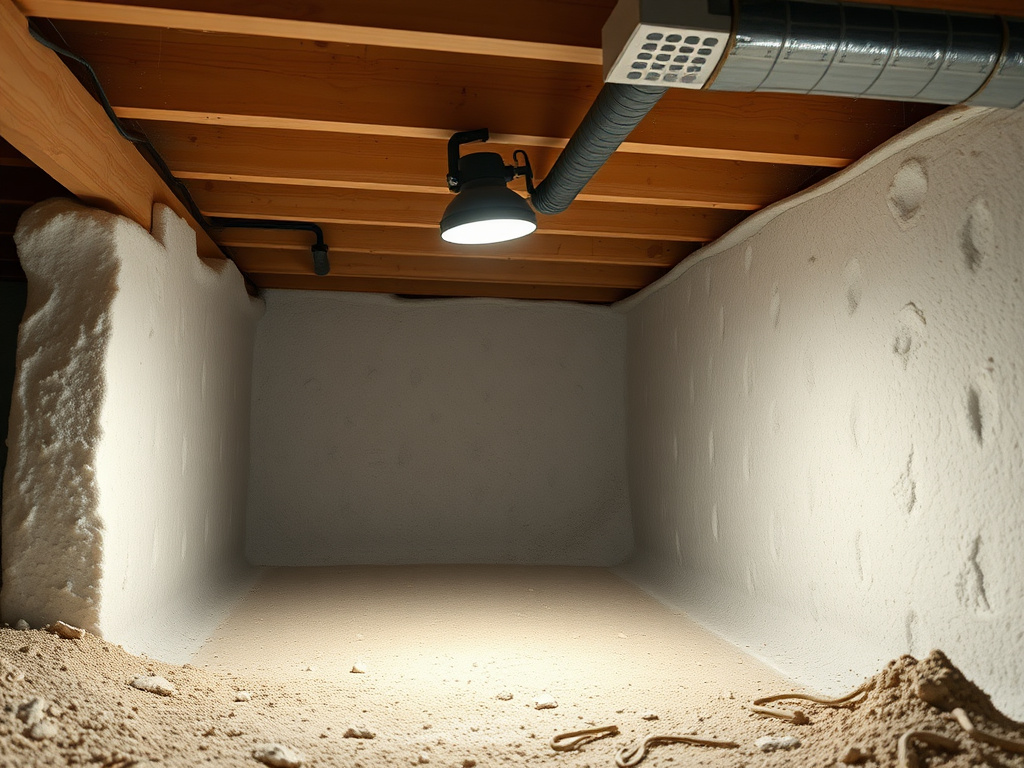
Crawlspace encapsulation with spray foam typically targets the perimeter walls of the crawlspace and the rim joist area where the foundation meets the floor framing above. Spraying the foundation walls converts the crawlspace from a vented space into a semi-conditioned one, which helps control moisture, reduces cold floors above, and keeps humid or musty crawlspace air from migrating up into the living space through gaps and penetrations.
The crawlspace floor is a different story. Spray foam is generally not applied directly to the dirt or gravel floor of a crawlspace. Ground moisture is a much bigger and more persistent problem than air temperature down there, and the standard fix is a heavy-duty vapor barrier sheeting sealed to the walls and piers, not foam. Spraying foam over ground that stays damp invites moisture problems rather than solving them, so a proper crawlspace job typically pairs foam on the walls and rim joist with a separate ground vapor barrier system.
Closed-cell foam is the typical choice for crawlspace walls because of its moisture resistance and higher R-value per inch, which matters in a space where wall thickness is often limited by clearance. Combined with the vapor barrier on the ground and, in many cases, a dehumidifier or conditioned air supply, this turns a damp, drafty crawlspace into a much more stable part of the house.
Rim Joists: A High-Payoff Detail
The rim joist — the band of framing that sits on top of the foundation wall around the perimeter of the house, right where floor joists rest — is one of the leakiest and least insulated areas in a typical home, even one that otherwise has decent insulation. It is often just a single piece of wood between conditioned space and the outside, penetrated by plumbing, wiring, and sometimes dryer vents.
Because the rim joist area is made up of many small, irregularly shaped bays rather than one continuous cavity, it is a great match for spray foam, which fills gaps and odd shapes far more completely than batt insulation ever could. Closed-cell foam is the common choice here because of its air-sealing performance and moisture resistance right at the foundation-to-framing transition, a spot where both are a concern. Rim joist foam is frequently bundled into crawlspace or basement jobs since the access points overlap.
Garage Ceilings and Basements
A garage ceiling with living space above it is a common target for spray foam, both for temperature control and for slowing the spread of vehicle exhaust fumes and odors into the house above. This application usually looks similar to a roofline job — foam sprayed directly to the underside of the floor sheathing between joists — and closed-cell foam is common here both for its air-sealing and its added rigidity, which can contribute to the fire and ignition-barrier requirements that apply to garage ceilings in many codes.
Basement walls follow a similar logic to crawlspace walls: spraying the foundation wall (above grade and, where accessible, below grade) helps control moisture and cold transfer through masonry or poured concrete, which is a common source of dampness and chill in finished or semi-finished basements. As with crawlspaces, closed-cell foam is the typical choice against foundation walls because of its resistance to moisture compared to open-cell foam.
Matching Foam Type and Thickness to the Space
A useful way to think about it: areas with direct moisture exposure or contact with concrete and masonry — crawlspace walls, rim joists, basement walls, below-grade applications — lean toward closed-cell foam because of its vapor resistance and structural rigidity. Areas that are dry, ventilated on the interior side, and cost-sensitive — like an attic floor in a mild climate — more often use open-cell foam, which fills a larger volume for less money per board foot.
Thickness is driven by the target R-value for that area and by local code minimums, which vary by climate zone and by whether the area is being converted into conditioned space. A qualified contractor should be able to explain both the foam type and the thickness they are proposing for each specific area of the house, not just quote a single blanket number for the whole job.
Frequently Asked Questions
It depends on the goal. Roofline spraying creates a conditioned attic and is common when ductwork or equipment is up there. Attic floor spraying keeps a traditional vented attic and is often simpler and less expensive in homes without attic ductwork.
Yes, through injection foam, which is pumped into closed cavities through small drilled holes rather than sprayed directly. It is a different product and process than open-cavity spray foam used in new construction.
Ground moisture in a crawlspace is usually better handled with a sealed vapor barrier sheet than with foam. Spraying foam directly over damp ground can trap moisture problems rather than resolve them, so foam is typically reserved for the walls and rim joist.
The rim joist area has many small, irregular gaps that are hard to insulate well with batts, and it sits right at a major thermal and air-leakage boundary between the house and outside. Spray foam fills those odd-shaped bays and seals air leaks in a way other materials struggle to match.
It is the common choice for crawlspace walls, basement walls, and rim joists because of its moisture resistance, but the right specification still depends on climate, wall assembly, and local code, so a contractor should confirm foam type for the specific project.
More Guides
Open-Cell vs Closed-Cell Foam
Density, R-value, moisture handling, and cost differences between open-cell and closed-cell spray foam, plus which one fits your project.
Read the guideR-Value & Energy Savings
What R-value really measures, why air sealing matters just as much, recommended targets by area, and realistic energy savings from spray foam.
Read the guideNew Construction vs Retrofit
How spray foam installation differs between open-stud new construction and closed-cavity retrofit work in an existing, finished home.
Read the guideReady to see what spray foam costs for your project?
Tell us about your space and get connected with a vetted local installer for a free, no-obligation quote.